Breast Cancer Diagnostics
An Explainable AI ensemble for FNA-based screening using supervised and unsupervised learning
Demo
Overview
In clinical diagnostics, a “black-box” prediction isn’t enough, clinicians need to know why an AI flagged a case as malignant. Developed during the National Canadian Medical Datathon 2026, this project aims to bridge the gap between machine learning and clinical intuition. We built a Triple-Validation Ensemble that provides a high-sensitivity diagnostic “second opinion” for breast cancer screenings.
Triple-Validation Ensemble Logic
Built with Shiny for Python, the core engine contains three distinct machine learning models to make predictions:
Supervised Layer (XGBoost): Optimized for 95% sensitivity (recall) to prioritize the detection of malignant cases and minimize dangerous false negatives.
Global Topology (GMM): An unsupervised Gaussian Mixture Model that identifies the mathematical “territory” of Benign vs. Malignant morphology.
Sub-type Clustering: A specialized GMM that identifies morphological patterns within malignant cells, acting as an anomaly detector to flag atypical cases.
Explainable AI & Spatial Justification
To move beyond simple probability scores, we implemented a Spatial Second Opinion feature to provide transparency for clinicians:
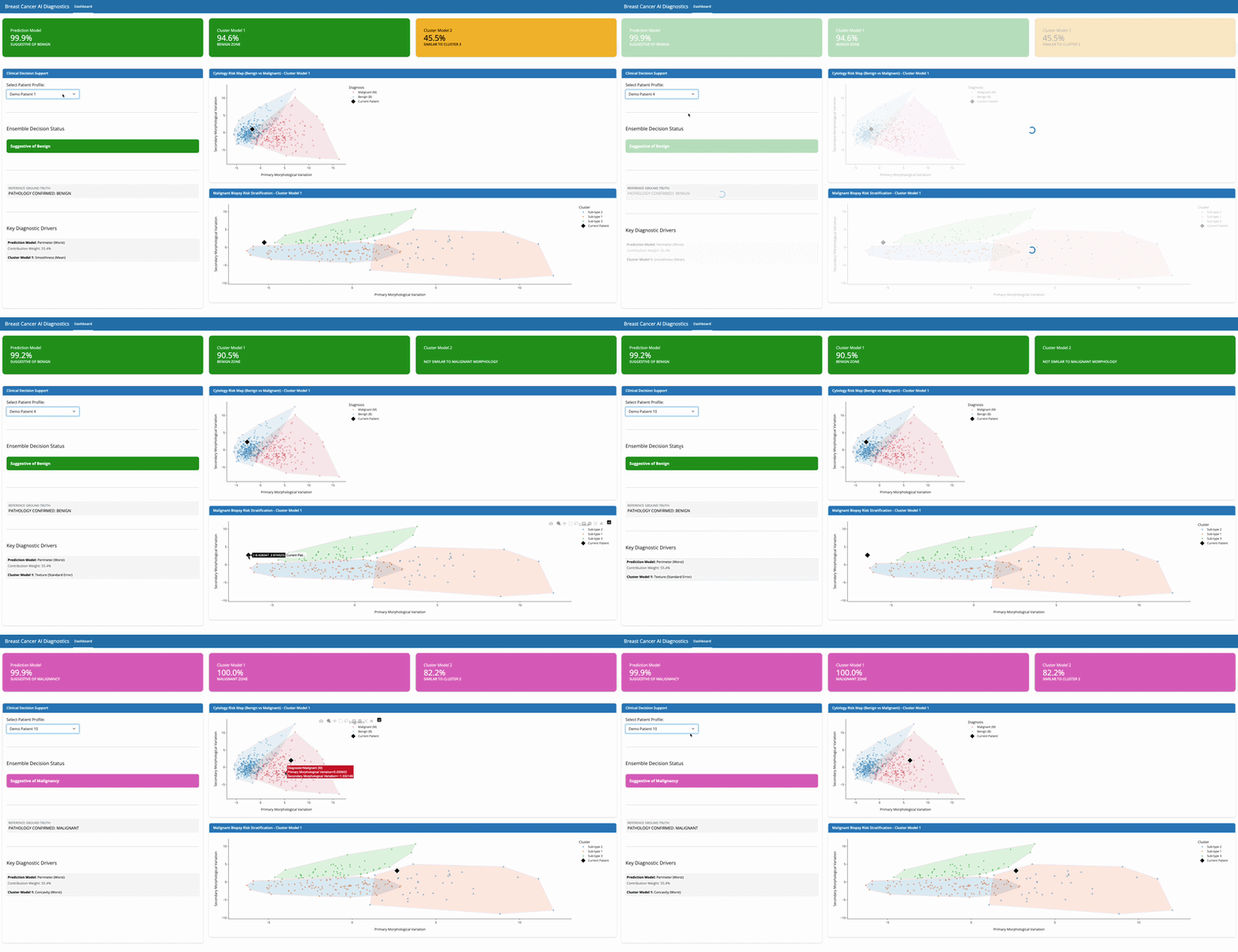
Morphological Mapping: Using PCA for dimensionality reduction, we project 30-dimensional cellular data onto a 2D topological map.
Geometric Boundaries: We utilized Convex Hulls to visualize the boundaries of known malignant sub-types. If a patient’s data point falls within these regions, the system provides a visual justification for the diagnosis.
Ensemble Consensus Alerts: Dynamic UI notifications that trigger “Critical” warnings when the supervised model and unsupervised maps disagree, highlighting edge cases for manual pathology review.
Interdisciplinary Collaboration
This project was a deep dive into Human-Centered AI. By collaborating directly with medical students and a Registered Nurse, we iteratively refined the dashboard to align with real-world clinical workflows. Their feedback led us to prioritize morphological visualizations over raw metric tables, ensuring the tool provides actionable insights rather than just data.
Performance & Reliability
To ensure the diagnostic hub is production-ready and mathematically sound:
Strict Data Splitting: Implemented a stratified sampling strategy to ensure the “Demo Cohort” remained entirely out-of-sample, preventing data leakage.
Reproducible ML Pipelines: Leveraged Joblib for serialized model deployment and Scikit-learn pipelines for consistent feature scaling and PCA transformations.
Reflection
This project was an incredible opportunity to apply machine learning to a high-stakes domain. It reinforced the importance of Explainability (XAI) in healthcare and demonstrated how unsupervised learning can act as a critical safety net for supervised models. Participating in this sprint over International Women’s Day weekend highlighted the impact data science can have on improving women’s health outcomes.
Credit
Collaborators: Built with medical students Abhinav Aggarwal, Kevin Dong, and William Lee, and Registered Nurse Lila Chan.