The Art of Folding
AlphaFold - breakthrough of the century in protein folding
Proteins are building blocks in our bodies and control vital body functions. They provide antibodies that protect us from pathogens, structures in our muscle tissues, and aid in the transport of oxygen in our blood. To understand how the body functions, we need to understand the structure of these molecules.
What is Protein Folding?
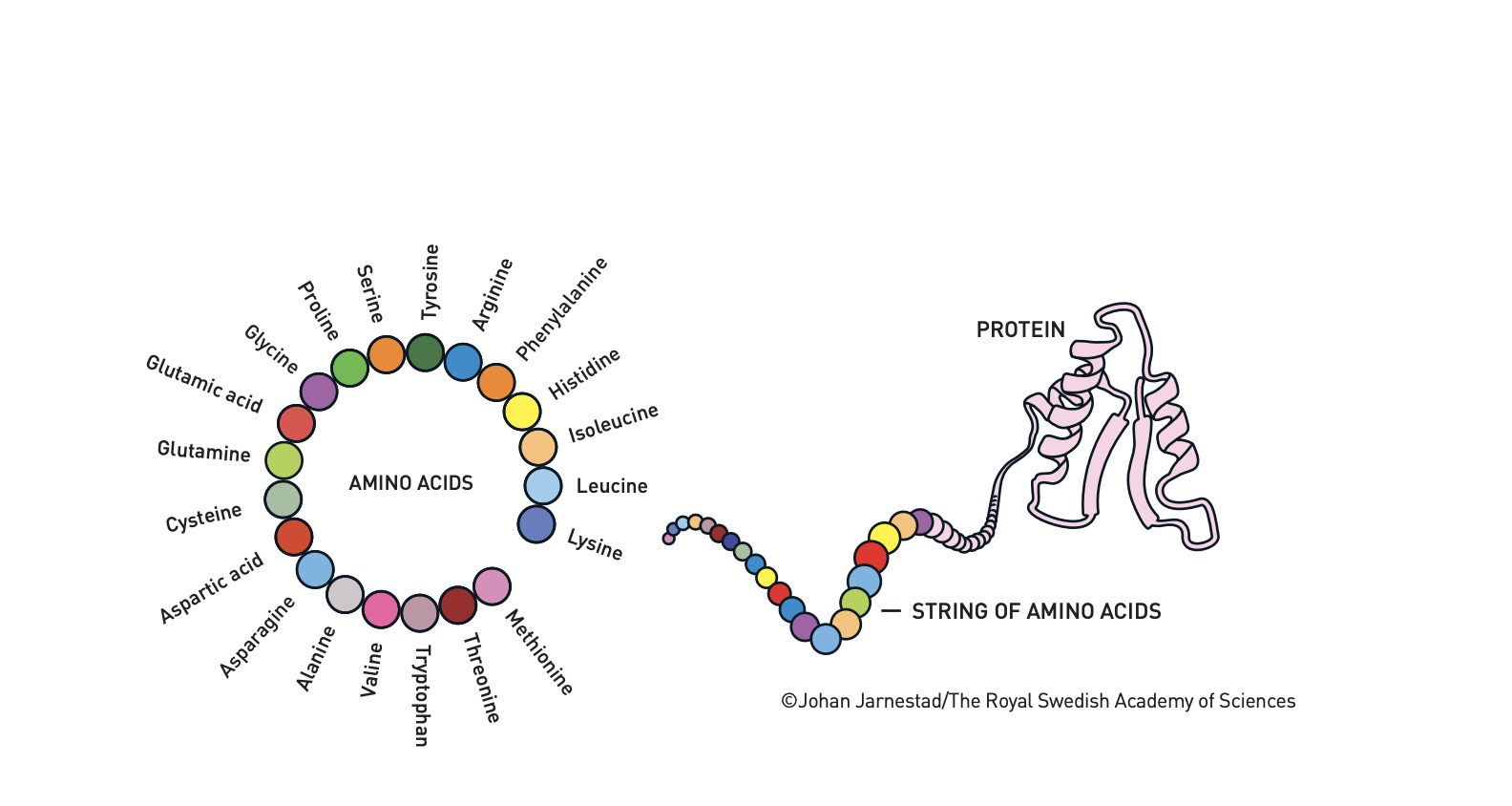
A protein is made up of a chain of amino acids sequence, which you can think of like a bracelet, with each bead as an amino acid. The sequence of a protein is encoded in the cell’s DNA. There are about 20 common types of amino acids, so you have around 20 different colour beads to make this bracelet. This bracelet can be formed into a 3D structure by bending and shaping it, which we call protein folding (see Figure 1). A protein’s shape determines its function, and knowing the shape is crucial for scientists to understand diseases and create new drugs to target them. But predicting its shape is extremely difficult. It’s as if doing origami with no instructions.
How Did Scientists Try to Solve the Problem?
Depending on the sequence of the protein, there are many interactions that occur between the amino acids, causing it to take on a highly specific and unique shape. Fifty years ago, scientists realized that if they were able to solve every single interaction in a protein sequence, then they could predict its 3D shape. However, the number of different combinations possible is astronomical.
In 1969, scientist Cyrus Levinthal noted that there are approximately \(10^300\) possible formations a typical protein can take, yet it is able to fold spontaneously within milliseconds. This was later known as Levinthal’s paradox (Zhang et al. 2025).
Experimentally determining the 3D structure of a protein is extremely laborious and can take months or even years. As of 2020, only about 170,000 out of more than 200 million known protein sequence has been solved (Service 2020). To tackle to this problem, some scientists to go the computation route, and turned to machine learning for the answer.
What is AlphaFold?
AlphaFold is a deep neural network (DNN) that can predict protein folding patterns.
What is DNN?
To understand how AlphaFold works, we have to look under the hood at deep neural networks (DNNs). Imagine you want to teach a computer to recognize a cat. The computer can’t “see” the cat has ears or whiskers. Instead, you show it thousands of pictures of cats and thousands of pictures of “not-cats.”
A DNN is a machine learning model that was constructed to mimic the structure of a human brain. It contains many layers, and each layer contains nodes that are equivalent to the neurons in our brain to perform calculations. The DNN “learns” through recognizing patterns. The first layer might detect simple edges, the next layer detects shapes like circles, and the final layer puts them together to recognize a face.
AlphaFold applies this same idea to protein structures. Instead of photos of cats, it was trained on all the known protein sequences and determined protein structures scientists spent decades solving. By analyzing the patterns in these known structures, AlphaFold takes in an amino acid sequence with an unknown structure, and it can predict a 3D protein structure.
Machine Learning Breakthrough
Critical Assessment of Protein Structure Prediction (CASP) is a protein folding competition that started in 1994. It is equivalent to the Olympics of protein folding. Every two years, the world’s best minds competed, attempting to solve the protein folding problem, but progress was slow.
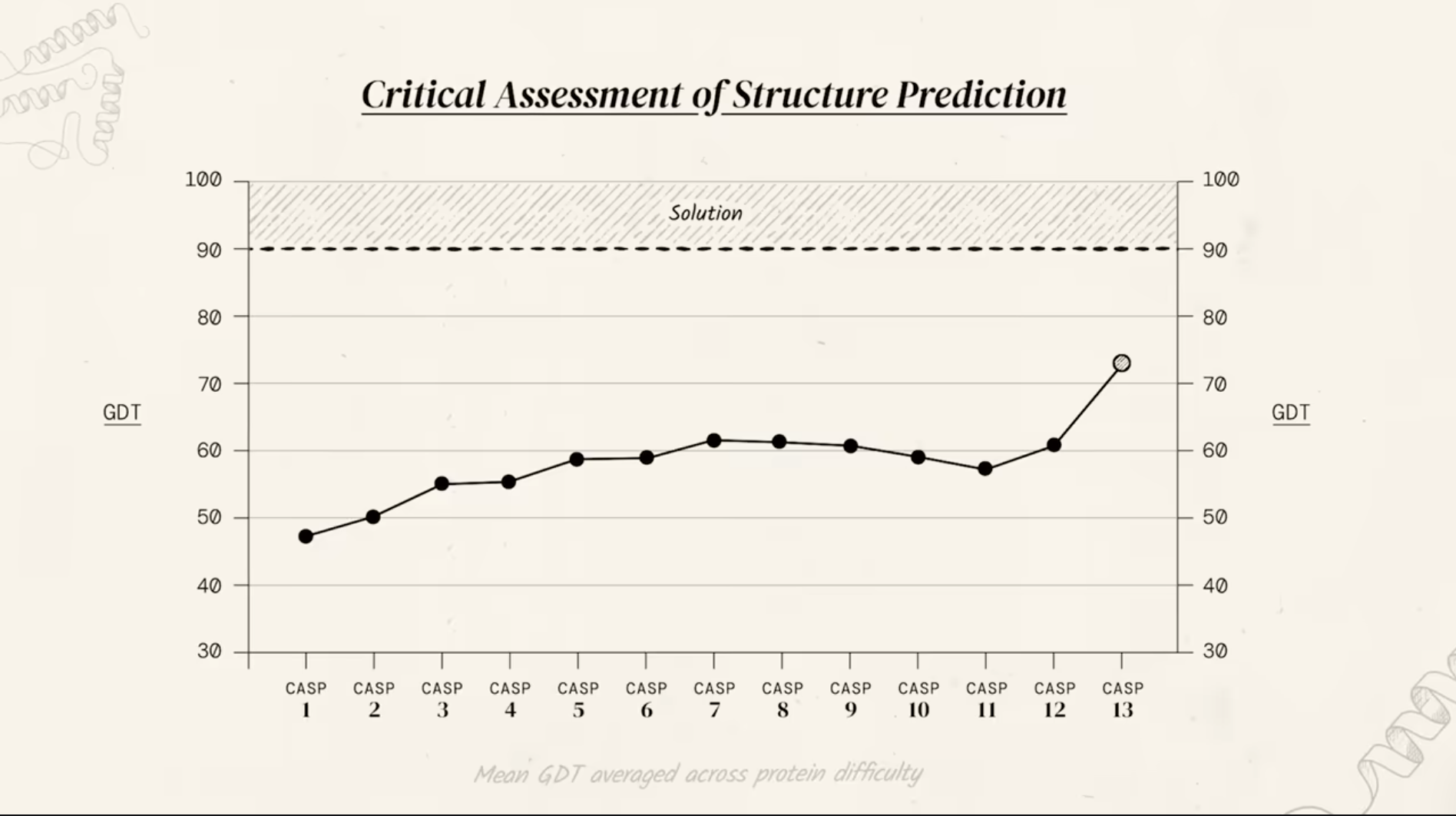
CASP has their own measuring metric called the global distance test total score (GDT-TS). The GDT-TS ranges from a scale of 0 to 100, a percentage of how well the predicted structure matches the target. From Figure 3, we can see a slow progression in the improvement of the accuracy over a decade. However, there was a drastic improvement in GDT score in the 13th CASP competition in 2018 (CASP13) compared to previous years. This breakthrough was due to the effective application of machine learning to predicting protein structures.
What is the Accuracy of using AI?
AlphaFold’s performance was awarded first place in the CASP13 competition. AlphaFold’s performance ranked the highest and was able to predict the general shape of the protein. However, it falls short in predicting the exact location of the atomic molecules in the structure.

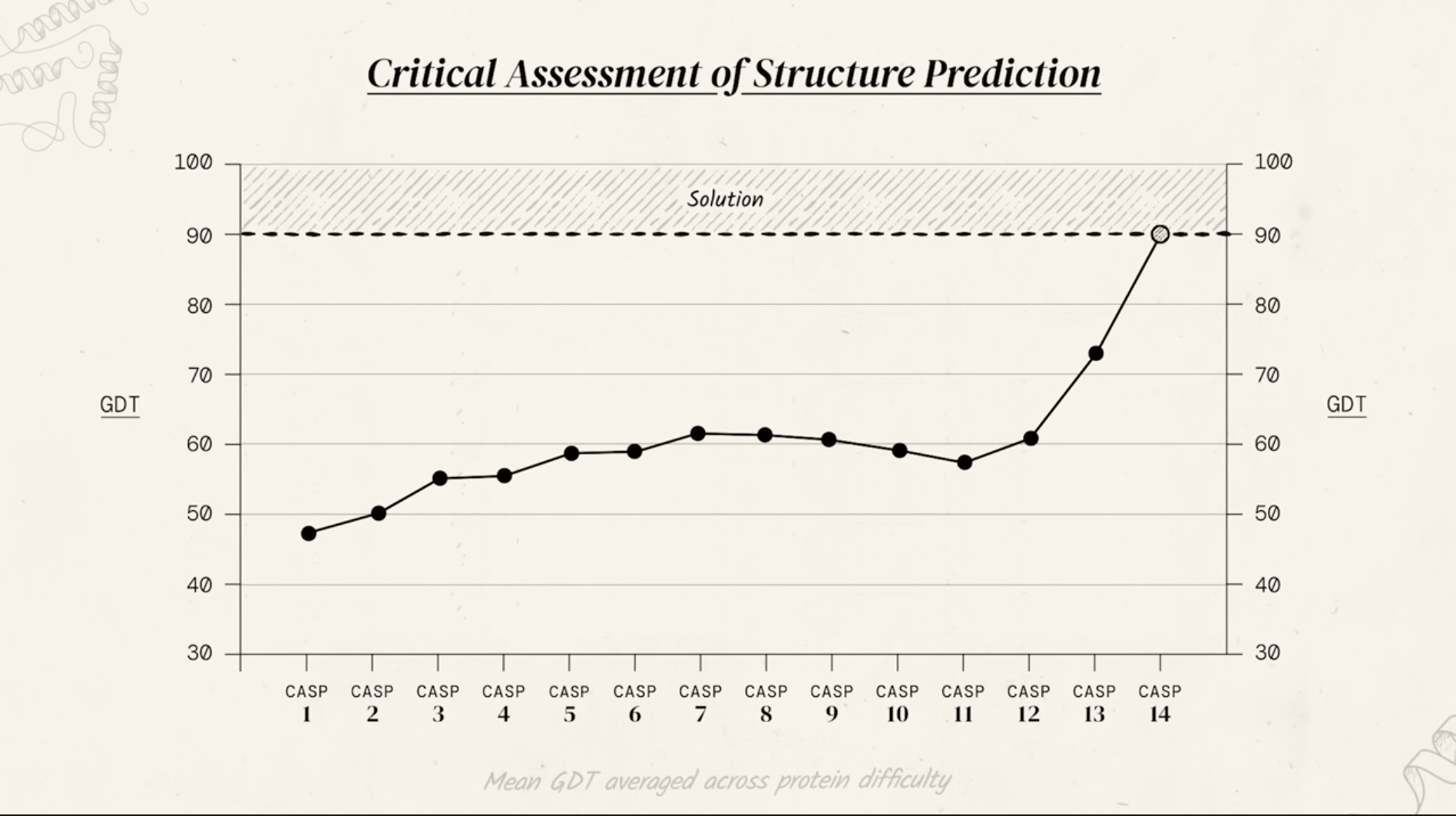
In the following year, the AlphaFold team went back to improve their model to develop AlphaFold2. At the 14th CASP competition in 2020, AlphaFold2 was able accurately predict the location of the very specific atoms in the structure. AlphaFold2 achieved a record-breaking GDT total score of 92.4 (see Figure 4), which was considered a similar level of accuracy to experimental results (Zhang et al. 2025). AlphaFold2 won the CASP14 competition by a huge margin and was recognized by the organizers of the CASP competition for being able to solve the “problem folding problem” (Google DeepMind 2024).
Why This Changes Everything
In 2024, the founders and developers of AlphaFold from Google DeepMind, Demis Hassabis and John Jumper, were awarded the Nobel Prize in Chemistry (Nobel Prize Outreach 2024). They were recognized for solving a problem that scientists have been struggling with for the past five decades.
Since then, AlphaFold has been used worldwide by more than three million researchers from over 190 countries (Google DeepMind 2024). This advancement is monumental, allowing scientists to design new proteins with desired functions and structures. A process that used to take years to solve now only takes minutes, calculated by a computer (Google DeepMind 2024). This breakthrough enables potential applications in drug development, diseases research, and protein engineering:
Accelerated Drug Discovery: Traditionally, designing a drug is like trying to make a key for a lock you can’t see. With AlphaFold, we can now “see” the lock (the protein structure) right away, allowing us to design better medicines faster.
Diseases Research: Many diseases affect developing countries that do not have enough funding for expensive experimental research. Machine learning makes studying these pathogens cheaper and more accessible compared to traditional lab techniques.
Environmental Solutions: Scientists are currently engineering proteins that can digest plastic waste. Knowing the structure is the first step to creating these “super-enzymes” that could help clean up the waste in our lands and oceans.
This represents a major leap not just in medicine, but also in biotechnology, agriculture, and the environment.